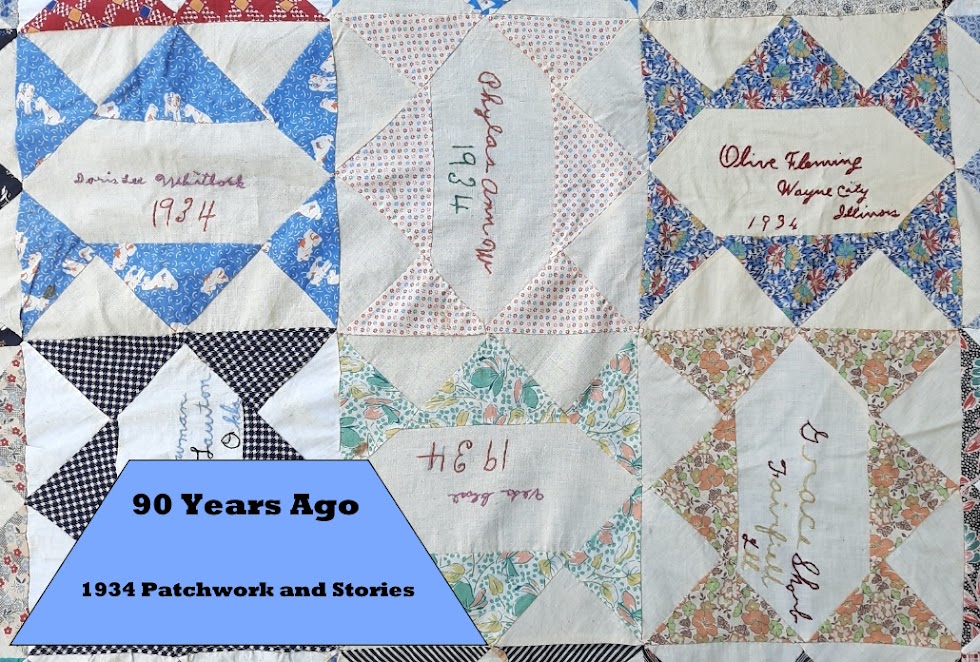
The following article was written in March 1934 by the Home Demonstration Agents in Hackensack, New Jersey. It contains instructions on making a quilt in under 500 words, quite a challenge in composition.
Because of the renewed interest expressed by a large number of women in making patchwork quilts, we have been asked for information on the steps involved in making a quilt. It is best for the first quilt to choose a simple pattern; by the way, we have in the office a copy of “One Hundred and One Patchwork Quilts”, as well as several quilt blocks made up. These are available for reference to anyone interested. The keynote of a successful patchwork quilt is accuracy in cutting the pattern and in construction.

A pattern made of pasteboard or metal will go a long way to insuring the accurate cutting of the pieces. Draw around the pattern on your material accurately allowing ¼ inch for the seam as the pattern itself does not allow for seams. Next, join your pieces according to the pattern making your block. To make this block unit join the pieces with three running stitches and one back stitch. It is possible to make a patchwork quilt by machine; however, as the attraction of this type of quilt is its old-fashioned aspect, it loses a great deal of its charm unless it is actually handmade. Women who find hand sewing too tedious or do not have the time to construct a quilt by hand would do well to make a different type of quilt.
 | |
| Sunbeam Block |
A commercial filling of thin cotton may be bought quite inexpensively. Unbleached muslin or any other cotton material may be used for backing. To quilt it is necessary to follow a regular design. Some commercial fillings include a design with their material. Having decided on the design which you wish to follow, draw or stamp it on the right side of the quilt.
 |
| Little Beech Tree |
Put up your frame and pin the backing of the quilt tightly on your frame placing the pins about 1 ½ inches apart. Next, lie your cotton on top of the backing smoothly. To result in its being flat, pin it here and there so that it will not slip. Stretch your quilting piece on top, pinning it tightly. Quilts thru three thicknesses, the quilt itself, the cotton filling and the back piece following the quilting pattern with small running stitches.
 |
| Double Nine Patch |
As you progress with your quilt, roll it under. When the quilt is finished, remove from frame and bind the edges. A more attractive quilt results from binding the edges with a bias strip using either a color to match the predominating color in your quilt or a piece of the material which is used for the backing.
The Record Hackensack, New Jersey March 14, 1934


