Wednesday, January 26, 2022

Air Castle in the Sky


Air Castle


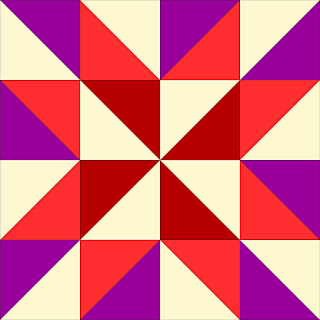
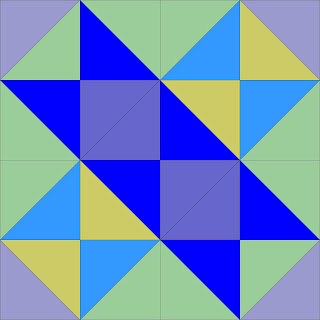
I am finishing a small quilt made entirely of traditional 9 patch blocks.  As my non-traditional computer lists the photos in alphabetical order, Air Castle is the one that heads the list. Air Castle was first offered as a pattern by the Ladies Art Company.  Nancy Cabot printed it in 1934.


Two years after the war of 1812 this interesting pieced block had its origin in Washington.  Geometrically classified, it is a nine patch, but the clever piecing makes it appear quite elaborate.  Rose, yellow, blue and white pieced blocks alternate with plain white.  The completed coverlet, quilted in a Star and Crown design, is of outstanding distinction.


Nancy Cabot    Chicago Tribune

30 July 1934


Air Castles


This Air Castles block is made with the colours suggested by Nancy Page.  Nancy Page must have been familiar with the other name for the pattern, Towers of Camelot. 

P.S. I am always amused by the direction - No Seams Are Allowed.  


“If you make the castles white and have the surrounding hexagon in light blue you can imagine that you see your fairy turrets on your castle, silhouetted against the blue sky.

“I’ll grant you that I am stretching my imagination, and asking you to stretch yours, when I call the points turrets of the castle.  But you can get a glimmer, can’t you, of what I have in mind?”

The members of the Nancy Page Quilt Club said it was clear as crystal to them and that they thought it would be fun to make this quilt.

They clipped the picture and directions from the paper. They sent for the direction leaflet.  On this they found the tracing patterns for the various pieces.  After they had these they traced them onto light-wight cardboard.  Then they cut out the patterns and laid them on the goods. They traced the outline with a sharp pencil and cut out the pieces, allowing one-eighth inch beyond the pencilled line on all sides.

This has to be done since no seams are allowed in the pattern.

In sewing the pieces together, they sewed on the pencilled line.

This design may be worked out in numerous ways.  For instance, the blocks may be set together with alternate squares of background material.  They may be white or it may be the same shade of blue as is used for the octagon.  Or the blocks may be set together end to end and side to side.  This gives an all over design which is quite different in effect from that of the single block.

Or they put the pieced blocks together with sashing.

Since there are so many ways to set these together it is difficult to say just how much material will be used.  The pieces all have straight edges so there is little waste in cutting.  Nancy thinks that nine yards of material will made enough to make a top for a double bed.  The size of this quilt will be 90 inches by 106 inches.  The edges may be bound in blue or in white or the plain white border which can be added may be cut into points.  The center square may be of a different color than the triangles shown in white.

It has many possibilities as you can see.

Nancy Page

The Birmingham News

January 19, 1937

Thursday, January 6, 2022

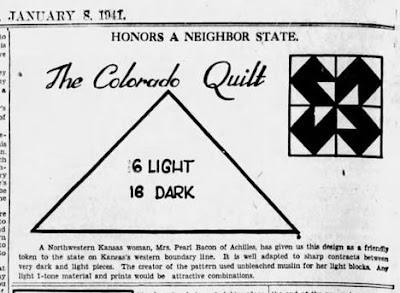
The Colorado Quilt from the Kansas City Star

 After twelve months of Nancy Cabot patchwork designs with exaggerated superlative descriptions it is a change to get back to the basics of the quilt blocks from the Kansas City Star.


A Northwestern Kansas woman, Mrs. Pearl Bacon of Achilles, has given us this design as a friendly token to the state on Kansas's western boundary line.  It is well adapted to sharp contracts (contrast?) between very dark and light pieces.  The creator of the pattern used unbleached muslin for her light blocks.  Any light 1-tone material and prints would be attractive combinations.

Weekly Kansas City Star January 8, 1941


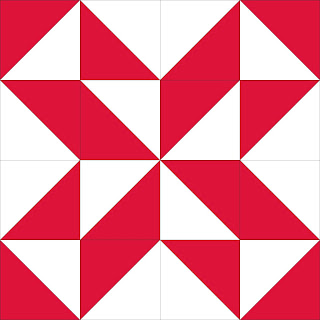
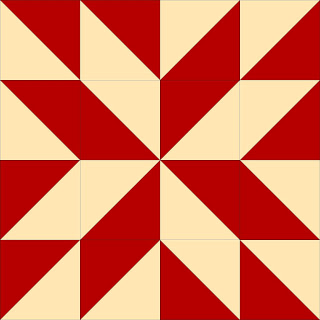
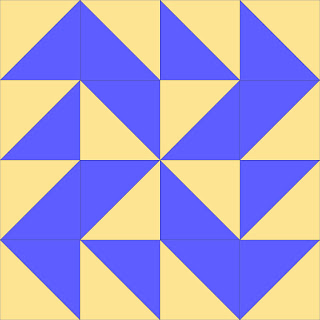
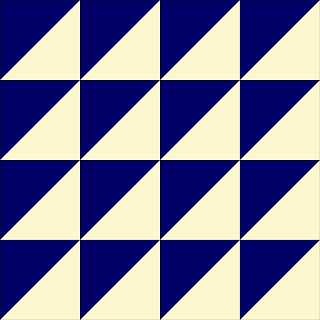
I made my sample with 16 half square triangles.  You can make a lot of blocks with 16 half square triangles.


Pieced Star   Famous Features


Anna's Choice   Kansas City Star


Yankee Puzzle   Ladies' Art Company


Margaret's Choice   Hearth and Home


Flyfoot   Ruth Finley


Mosaic #17   Ladies' Art Company


Chisholm Trail   Kansas City Star


I'm not a fan of half square triangles but they are extremely useful things.

Wednesday, December 29, 2021

Farewell to 2021 - Sunbeam Crossroad

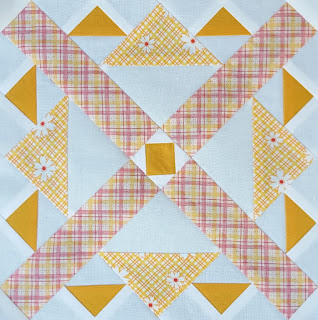
 At the start of 2020, my New Year resolution was to share a quilt block form the Kansas City Star each day on my Facebook page Two Bits Patches.  It was so much fun that I continued into 2021, this time sharing patterns from Nancy Cabot in the Chicago Tribune.  On Christmas Day in 1935 the quilt pattern was Sunbeam Crossroad.


Sunbeam Crossroad


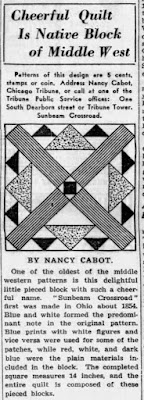
What a cheerful name!  This is how it appeared in the Tribune 86 years ago.


One of the oldest of the middle western patterns is this delightful little pieced block with such a cheerful name.  "Sunbeam Crossroad" first was made in Ohio about 1854.  Blue and white formed the predominant note in the original pattern.  Blue prints with white figures and vice versa were used for some of the patches, while red, white, and dark blue were the plain materials included in the block.  The completed square measures 14 inches, and the entire quilt is composed of these pieced blocks.


My block is nine inches, and I had to use sunny colors, not blue and white. And that finishes 2021 in my sewing room.  And 2022?  Lots more newspaper patterns to come!


Sunday, December 19, 2021

Friendship Dahlia


The Friendship Dahlia appears to be a most popular quilt block in the 1930s.  It is an applique pattern with eight overlapping petals, a stem which was curved or straight, and a center circle to cover the petal points.  It was a "friendship" block because to get the variety of prints desired the quiltmaker needed to swap materials with her friends.  The block was also made without the variety as shown below (the overlapping petals were a bit challenging for Alma Hampton.)


The Friendship Dahlia design was an Aunt Martha favorite,  pattern number C397.


The instructions state to "crease to find the center and place eight petals around it."  If you look carefully at the first block pictured you can see the diagonal creases in the top corners.  Friendship Dahlia was printed in Aunt Martha's Favorites No. 3230.  The Aunt Martha patterns were also available by mail and were advertised in the newspapers.  


One may search a long time before finding a more beautiful design than this Friendship Dahlia.  The petals are made from with different prints, with a yellow center and a green stem - all to be appliqued on a white block.  The thirty blocks may all be the same flower, or by using small pieces of leftover materials the flowers may be variegated.  Cutting pattern and instructions, C397, 15c.  Order by mail only.  Allow a week to ten days for delivery.  

December 17, 1932   The Chattanooga News   Chattanooga, Tennessee


Nancy Cabot published the Friendship Dahlia in the following year, and again the year after.


A very modern design is the "Friendship Dahlia" - not nearly so old as the venerable "Friendship Ring," for which it was designed as a companion.  The different prints which formed the sections of the ring were originally furnished by various friends.  Prints of gay little chintz pieces will make a pretty dahlia.

May 28, 1933   Chicago Tribune   Chicago, Illinois


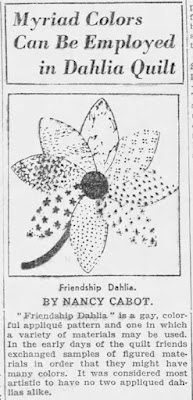
Friendship Dahlia is a gay, colorful applique pattern and one in which a variety of materials may be used. In the early days of the quilt friends exchanged samples of figured materials in order that they might have many colors.  It was considered most artistic to have no two appliqued dahlias alike.

December 19, 1934    Chicago Tribune   Chicago, Illinois


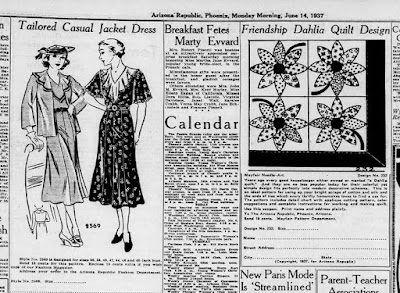
Another pattern in another newspaper.


Years ago every good housekeeper either owned or wanted "a Dahlia quilt."  And they are no less popular today for their colorful yet simple design fits perfectly into modern decorative schemes.  This is an ideal pattern for using up your bright scraps of cotton and silk and the ends of ties which every thrifty homemaker loves to find a use for.  The pattern includes detail chart with applique cutting pattern, color suggestions and complete instructions for working and making quilt.
 
June 14, 1937   Arizona Republic   Phoenix, Arizona