Saturday, December 8, 2018

Jingle Bells and Sleigh Rides

It's Christmas Carols by Candlelight season in Australia.  The candles are now LED lights.  Santa comes by Country Fire Authority firetruck - if the truck isn't out fighting bushfires.  Carols are always outside in the evening - unless there are thunderstorms or a heatwave.  And we still sing about dashing through the snow and sleigh rides.  It's mad but it's Christmas.


In my e-book "Round is the Ring" I included the wedding story of Sarah Stubbs and Jacob Swayne.  Sarah Stubbs made a block in the Chester Criswell Quilt and she married Jacob on 24th January 1857.  The couple's honeymoon included a lot of snow and sleigh rides, and was re-told at their 50th wedding anniversary in 1907.


They were married at the home of the bride’s parents in Peach Bottom Township, York County.  At the time both were members of Fawn Grove meeting, York County. On the day of the wedding the country was deeply snowbound and the blockaded roads made traveling unsafe and impossible.  About 50 people had been invited to the wedding, but only ten succeeded in reaching the house.  Outside of the immediate members of the Stubbs family three of the ten guests referred to at the wedding are living: Elizabeth Stubbs of Delta, widow of Vincent G. Stubbs; Hannah Stubbs of Kennett Square, widow of Reuben Stubbs; Mrs. William Moore of York.  Three brothers of Mrs. Swayne, who were present, are also living – Daniel and Thomas Stubbs, residing on the old homestead, Dr. Henry Stubbs of Wilmington.


The wedding journey was so different in travel compared with the present day of swift and comfortable transportation that we give some of the important points for the edification of this generation of brides and grooms.  The following morning Jacob and his bride in a sleigh behind a pair of willing mules, started and drove across the frozen Susquehanna to Peach Bottom.  They were accompanied by Albert Stubbs and Phebe Hickman and Reuben and Hannah Stubbs, all in sleighs.  Near Cherry Hill Albert’s sleigh broke down.  While repairs were making in Wakefield the party stopped for two hours in the store which John and Samuel Wilkinson kept in the village.  Below Wakefield there is a spring and close to it Albert’s sleigh upset, he and his friend alighting in the snow.  Through fields and across roads the party continued on their toilsome way.  At nightfall they reached Oak Hill and inquiring about the roads were advised not to go any further.  They decided to remain over night at the home of Nathan Haines, nearby.  Driving carefully down the long lane they reached the house at a late hour and called Mr. Haines out, who received them in a friendly manner and entertained them until morning.  Of the large family at this homestead at the time – ten persons in all – but one is now living, Elizabeth L. Brinton, Oxford, who has a vivid recollection of the event.

Amid the unlimited expanse of snow a start was made next morning and Russellville reached by noon, the party stopping for an hour or two.  As the Limestone road was fence-top full of snow the party drove through fields, going by way of Faggs Manor to the White Horse.  At Joseph Pennock’s, the other side of the latter place, the drifts were immense and by permission of Mr. Pennock, Jacob sawed a panel out of a new fence in order to drive through his yard.  Doe Run was reached by dark, then Unionville and on through field and roads to Willowdale before nine o’clock – the home of Jacob’s parents.


In conclusion Mr. Swayne tells us he and his wife spent about ten days at the home of his parents.  They then started for York County, Albert Stubbs and lady accompanying.  The party stopped at the home of Samuel Passmore, near Chrome.  Mrs. Passmore is a sister of Mrs. Swayne.  Next day the party resumed their travel on runners, the roads in more passable condition, Mr. Passmore and wife having joined them.  All drove to Peach Bottom and proceeded in their sleighs over the frozen river to York County.  This statement is made to show that the Susquehanna was frozen over that winter, another paper having said that it was not.


It's a wonderful story.  And this is the last post for 2018.  I hope you join me again in 2019, there are some changes afoot and some nice surprises. Merry Christmas!

Thursday, November 15, 2018

Signature Quilt Alert - Pambula, NSW

Historically, signature quilts in Australia were primarily fund raising quilts. Red embroidered signatures on white backgrounds was a standard layout around the world to raise funds during WWI.  The Red Cross provided guidelines to organise such a quilt but they were made by many community groups.

Romsey Quilt - Red Cross Collection, Victoria

Cheltenham State School - Red Cross Collection, Victoria

Not a lot of these Australian quilts are still in existence.  There seems to be less than two dozen documented quilts but they are not often on display.

Recently I discovered a reference to another one of these Red Cross quilts.  This newspaper article was first published in the Pambula (New South Wales) 'Voice' on 26th March 1937, and then appeared in the Delegate (New South Wales) 'Argus' on 1st April 1937.


Historic Quilt
Presented to Hospital

At last Saturday night's Red Cross meeting, the president (Mrs. D. V. Hart) handed to Mrs. C. A. Woollard (secretary of Pambula Hospital Auxiliary) a quilt of historic interest. It appears that, away back in the early days of the war, the late Mrs. J. W. Haywood, then president of the local Red Cross and a foremost patriotic worker, suggested the idea of raising funds by working names of soldiers, local people and visitors on a quilt at a charge of 1/- (one shilling) each. The intention, Mrs Woollard stated, on Saturday, was to present the finished article to the hospital for the use of returned soldier patients from time to time. Scores of names were duly worked on the quilt by local ladies, and many memories of other days and people who have left the district were revived by a look at the finished article on Saturday night. Among them we noticed the names of Professor Peden and the late Sir Austin Chapman, once Federal member for the electorate. Mr. Graham, Red Cross Commissioner, suggested that as the quilt was an article of great sentimental value is should be placed in a glass case and kept at the hospital entrance as a memento, but it was decided to observe the original intention. Mrs. Hart therefore made the presentation, and Mrs. Woollard suitably acknowledged it on behalf of the auxiliary.

What a great story - but so many questions!  If the quilt was started in 'the early days of the war', say 1915, why was it being presented in 1937?  Did it take 22 years to make, or was it waiting for Mrs. D. V. Hart to finish the quilting? How long did the quilt last in a hospital laundry? And what is the likelihood that it still exists?

I haven't found any other references to this quilt.  Both Professor Peden and Sir Austin Chapman had very productive and interesting lives. Pambula is a lovely place for summer holidays, next time I am there I will look for some answers.

Friday, November 9, 2018

The Godey's Lady's Best Bits Book

My newest e-book is live and ready to roll.


It's collection of some of the best bits of the Godey's magazine and demonstrates what it was like to be a woman of the 19th century.  


"This is the ‘Lady’s Book’ par excellence. We admire this work, for the plain and simple reason that, like refined, polished, and virtuous female society, it powerfully tends to improve the manners and mend the heart"


It's a Kindle book but you don't need a Kindle to download it - I download to my phone.

Prices are US $2.56 / Aust $3.53 / UK £1.96.  

And if you do get a copy, please let me know if you like it.


Thursday, November 1, 2018

London Square

This week's block is a mystery block. This week's block has found a name as the post was being written.


London Square


As you can see, the seamstress found all those bias triangles a bit of a problem.  The block doesn't sit flat and there are little tucks all over the block to join the larger triangles with the pieced sections. The top right hand quarter was pieced first with uniform scraps.  Moving counter-clockwise each quarter adds more prints as the maker running out of material and perhaps patience.


Reverse of London Square - very even stitches


It is hard to search for a block when you don't know what it is called.  I started with a block I did know, Corn and Beans.


Corn and Beans


As I looked though references for blocks similar to Corn and Beans I found a block called Linton from the Ladies Art Company.  It was close to my block, just one more triangle in each row.


This is Linton from BlockBase. BlockBase also has a block called London Square with even more triangles.


More Googling; this time I found London Square in Barbara Brackman's Civil War blog.  This London Square is one quarter of my mystery block but the triangles are the same in number.


Barbara Brackman says that London Square is a variation of Ocean Waves - which coincidentally was my last blog post.  My Little Linton block is now christened London Square. No more mystery.

Friday, October 19, 2018

Ocean Waves

This week's block is Ocean Waves.


Ocean Waves is one of those blocks that looks lonely by itself.  It's a party block, it feels best when hanging out with friends.


IQSCM collection dated 1900


Sandra Starley's blog has another antique Ocean Waves quilt.

Ocean Waves appears in the 1931 catalogue The Patchwork Book. One thing I have found curious in this magazine was the continual references to the colonial women and their patchwork.  I don't think American colonial women were making patchwork blocks, the 1700s were too early for patchwork.

Barbara Brackman addresses this issue in her latest blog, Women's Work: Quilts.

In the early to mid-20th century popular quilt writing was valued more for mythology than accuracy. Nostalgia for an imagined colonial and pioneer past fed a sense of national pride. Patchwork quilts were survivors that seemed to support that argument. Curators, popular historians and pattern companies shaped their stories to fit the myth.

The image: An isolated woman working alone, recycling scraps from her ragbag, clever and artistic enough to imagine new patterns named for geese, bears and turkeys as she glanced out her cabin door at the wildlife. Occasionally finding respite from her solitary life in a group quilting bee.

Ahh. So it's the Romance of the Patchwork Quilt (yet another book from the 1930s.)

Thursday, September 27, 2018

Martha Washington

As I was sorting out some files in the sewing room I came across the name for another one of my new antique blocks.  At this rate I will have them christened in no time at all.

Martha Washington


For those who don't know, Martha Washington was the first First Lady as she was married to George Washington.  She was know for her quiltmaking; guests to Mount Vernon would find their bed covered with a dozen quilts, each one needing to be admired and folded before there was room to sleep in the bed.


Mount Vernon, Va. Flower Garden postcard by the Mount Vernon Association, 1926


Thursday, September 20, 2018

On the Hunt for a Name

Yesterday was exciting, a parcel came in the mail. 


Hooray! A new lot of blocks to play with!  They are big blocks, most are 15 inches.  They are perhaps not quite as old as I expected but there are some old fabrics and a mix of hand pieced and machined pieced.  As usual when buying online, the photos were closely examined.  The following was one block that said, Pick Me!


Have you seen this one before? I haven't.

While I was waiting for these blocks to arrive I received another package.  It's a CD-Rom of the Kansas City Star quilts published from 1928 to 1958.  There are over a thousand files, each one a copy of a quilt pattern published in the newspaper.  I do prefer original books but ...  a thousand patterns! How could I resist. 

Not to sure on how to get through so much information I decided to start, logically with the A's. Airplane, Album, Amethyst, Anna's Pride, Arkansas Centennial/Crossroads/Star, Arrow Head .....


Arrow Head.


(Clip and Save.) The contributor of this quilt pattern, Mrs. Mattie Cron, rural route No. 3, Mulhall, Ok., is a quilt fan who likes to share her favorite designs with other enthusiasts. She just has finished a quilt made by this pattern in rose and white.  The block is twelve inches square. - 29 Jan 1936


That wasn't too much of a hunt, my new block is an Arrow Head.  It also demonstrates something that I did not know.  I had assumed that the Kansas City Star quilt patterns were designed by professionals like Ruby McKim.  But the vast majority are blocks contributed by women to the newspaper in the hope of getting published.  Thank you Mrs. Mattie Cron - although that right angled white piece is going to take some skilled needlework to fit.

Thursday, September 13, 2018

Duck, Duck, Goose Tracks

Again this week, a block with several names.


Goose Tracks

Goose Tracks seems like a logical name for this one but it isn't the only name.  Woman's World calls it Signal; imagine a lighthouse or beacon sending out a signal light.


The Kansas City Star went for Cross and Crown.

This quaint old pattern with its "firm-in-the-faith" title is really a variation of the lily blocks which have flowers resembling these "crowns" combined with applique stems, leaves, with perhaps a pieced basket corner as was shown at another time. "Goose tracks" is also quite similar in pattern but of course less dignified in name!  This is one of the more simple quilts to piece, the finished effect varying considerably in relation to the way it is set together.  With red lattice strips joining white squares at the corner the pattern stands out entirely different than when white strips or large squares are used, or again the background may be light with darker design.  Allow seams extra; about 3/16 inch is right for this on all sides.

Just remember that this picture and comments are the complete instructions to sew the entire quilt; no more information was supplied.


This Goose Tracks hand sewn block was made a little differently.  It isn't pieced, it's reverse applique. 


This is the back of the block, which started as a nine patch.


Three gingham pieces were appliqued on the corner patch to make the goose track. Gingham wasn't possibly not the best choice in this situation.


Not much contrast but another block of the same pattern.  This sampler quilt was made in 1939 and the maker wrote the name of each block on the quilt.  And her name for this one?


Duck's Foot in the Wind.  I wish I knew the back story for this one.

Thursday, September 6, 2018

A Friendship Quilt Block

... or, a Friendship block quilt.


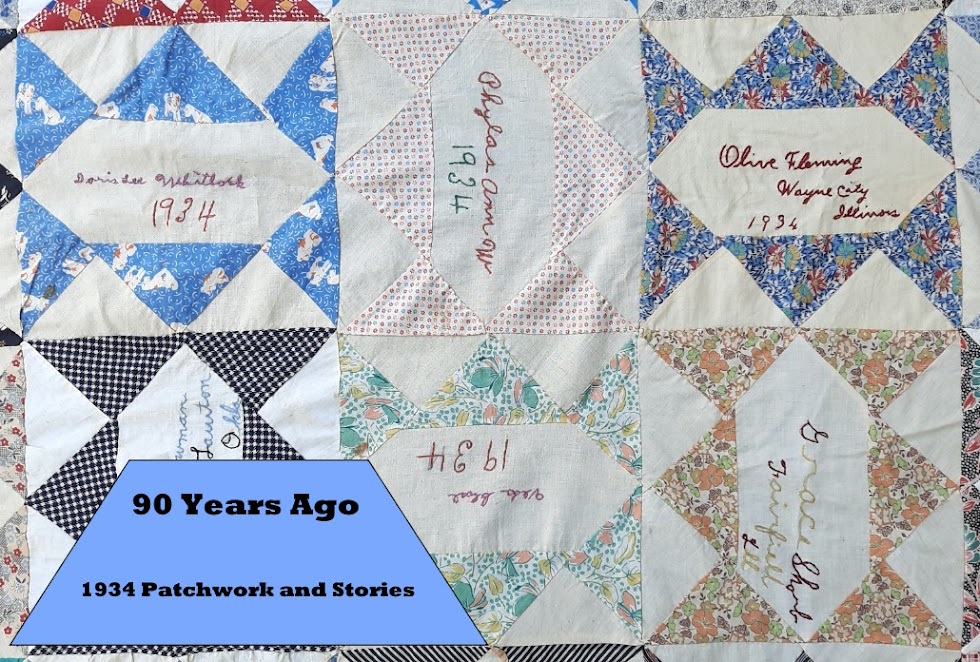
These two blocks sit side by side in this quilt by the Banner (Oklahoma) Progressive Club, 1938.  The block is called Friendship Quilt BB2895 from Kansas City Star.


This quilt may have white strips for the names of friends to be embroidered.  The strips may be in solid color.  This was contributed by Mrs. Delia Davidson. Vilas, Colorado. Thank you.


The Kansas City Star printed more than one pattern named Friendship Quilt.  It must have been a useful generic label, my index for KCS includes nine different Friendship Quilt blocks.


On the quilting pile