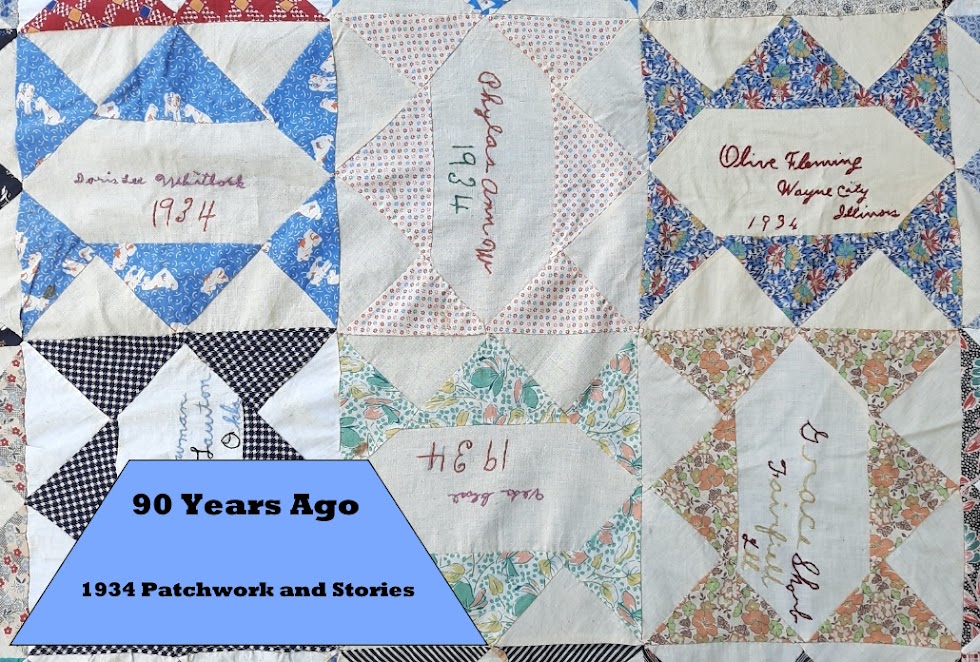
I haven't seen this block yet but it is flying halfway around the world to greet me. Nancy from Tattered Garden Quilting was concerned about signing a block for the first time, and this is her maiden effort. How good is this signature! A few comments on her blog asked about the pen she used, and Nancy has done a post about her pen trials. Nancy used a Pigma Pro, I used the Micron pens. I have been tracing my signature from the laptop screen, but I can see that it is time to lift my game.
The best book I've seen on signing blocks is Pepper Cory and Susan McKelvey's "The Signature Quilt". I re-read the section on "Embellishing Handwriting" and decided to give it a go. I started with lined paper and the first ball-point pen I could find. I followed the hints in the book and started doodling.
It was quite enjoyable. I haven't quite got the look I want, although I am happy with the 'Australia' in the bottom left hand corner.
I need lines to keep my writing straight. If I have some sort of stabilizer on the back of the block I will rule some dark lines on that, then use them as a guide to write on the front.
Patti left this comment on the last post about signatures. Thank you Patti, it's just what I needed to hear.
I've finally stopped worrying about how I sign my blocks. My handwriting has deteriorated lots as I've gotten older and my hands get more arthritic. I used to agonize about my signature, but now I don't. I make sure the writing is legible, but that's it. I don't try to be fancy. Remember, your handwriting is individual and belongs to you alone. I'd much rather have the block creator's own writing on a signature block as it is a part of who she is - just as much as the fabrics she selected when making the block.
Showing posts with label autographs. Show all posts
Saturday, May 25, 2013
Friday, September 21, 2012
The Autograph Age Part 2
Some of the participants in the Chester Quilt added a verse to their quilt block. Mary Criswell's verse reflects her receipt of the quilt as gift from her friends.
'My album is a garden plot
Here all my friends may sow,
Where thorns and thistles flourish not
But flowers alone will grow.'
Mary's best friend Martha Lambourn made an identical block to Mary's. Her verse could be on behalf of all Mary's friends.
'Not I alone, this wreath will twine
But all thy friends who write a line
In this receptical of thine
Shall form the wreath in unity.
This album's then's a wreath for thee
Sacred to love and memory
And every name a flower shall be
A pure bright gem of constancy.'
Mary's sister Margaret continues the garden theme.
'The golden sun of summer
Hath never shone more fair
Than on the odour of the dying flowers
Which lies so sweetly on the air.'
'Like a leaf we all must die.'
Margaretta goes for a round about message with round about writing.
'Round is the ring that has no end
So is my love for you my friend.'
But Jane Trayner has the last word with the classic:
'Remember me when this you see.'
Tuesday, September 11, 2012
The Autograph Age
Do you remember when Laura Ingalls received her autograph album?
Autograph albums were indeed all the range in the 19th century. Their heyday was from 1830 to 1850. Signature quilts are a phenomena of this period too. One important development was the invention of permanent ink in 1845; signatures written 150 years ago are still legible today.
The role of women changed through the nineteenth century as a rural farming lifestyle was overtaken by an urban industrial society. Men went to work in the 'public' world; women stayed at home in the 'private' world of family. Women turned to each other for friendship and support, and their signature quilts recorded family relationships and rites of passage.
Sources: Little Town on the Prairie by Laura Ingalls Wilder; The Signature Quilt by Pepper Cory and Susan McKelvey
Pa and Ma had taken Mary to the college for the blind and left Laura, Carrie and Grace on their own for a week. Laura was 14 and Carrie was 10, Grace was even younger. Not something we would do today. Laura decided to do the fall house cleaning and the week was spent washing, scrubbing and blacking the stove. When the elder Ingalls returned there were presents for the girls.
Ma signs Laura's book a few chapters later.In Laura's package was a beautiful small book, too. It was thin, and wider than it was tall. On its red cover, embossed in gold, were the words, 'Autograph Album'. The pages, of different soft colours, were blank. Carrie had another exactly like it, except that the cover of hers was blue and gold.'I found that autograph albums are all the fashion nowadays,' said Ma. 'All the most fashionable girls in Vinton have them.''What are they, exactly?' Laura asked.'You ask a friend to write a verse on one of the blank pages and sign her name to it,' Ma explained. 'If she has an autograph album, you do the same for her, and you keep the albums to remember each other by.'
Autograph albums were indeed all the range in the 19th century. Their heyday was from 1830 to 1850. Signature quilts are a phenomena of this period too. One important development was the invention of permanent ink in 1845; signatures written 150 years ago are still legible today.
The role of women changed through the nineteenth century as a rural farming lifestyle was overtaken by an urban industrial society. Men went to work in the 'public' world; women stayed at home in the 'private' world of family. Women turned to each other for friendship and support, and their signature quilts recorded family relationships and rites of passage.
Sources: Little Town on the Prairie by Laura Ingalls Wilder; The Signature Quilt by Pepper Cory and Susan McKelvey
Subscribe to:
Posts (Atom)


