Thursday, March 21, 2013

Sneak Peek - Shirtings 1895

I have a day at home today.  I am celebrating Johann Sebastian Bach's birthday * by listening to a CD of organ works while I pin baste my recently finished quilt top.

Shirtings 1895

The old sampler quilts appeal to me.  I love the randomness of the different size blocks, the filler blocks and the not quite straight edges.  I had collected some shirtings here and there (as one does) and looked for blocks that were in quilts from the late 1800s.  I copied some of the blocks in my own collection.  To get the random feel I made each block in a size that suited the pattern, and used the ends of strips to make flying geese and half square triangle filler blocks.  When I had 12 big blocks I put everything on my design floor.

It wasn't very easy to arrange the multi-sized blocks.  In was, in fact, very frustrating.  I was trying to do the whole top at once and it just didn't come together.

Finally I choose four blocks that did fit and sewed them together.  Then I added a row of flying geese, and that looked okay.  I kept adding blocks of blocks that pleased me, and made a few more as necessary.  I filled in gaps with leftover strips without worrying about the colours.

I am pleased with the result.  I'm getting it finished to put in my patchwork group's quilt show next month and I will be interested to see what the reaction of my fellow quilters will be.  Not everyone likes random.

More on shirtings - Barbara Brackman's Material Culture blog has a recent posting on shirting prints.  Shirting fabrics were very popular for men's shirts, and become a fad for women's shirts in 1910.  There's a link to Moda Fabric's blog with a post on today's equivalent of shirting prints - low volume prints.

I bought this shirt in an op shop last year.  It's black on yellow and I thought of shirting prints when I saw it.


The design is ... interesting.


* Wikipedia states that J S Bach's birthday is 31st March.  I have been certain for years that his birthday was 21st March. I still enjoyed the CD.


Monday, March 18, 2013

Almost Too Many Sewing Machines

On the long weekend we visited Maryborough in central Victoria and discovered the Flour Mill Gallery - home to an amazing sewing machine collection.
The Flour Mill Gallery at Maryborough
The collection is five years old and still growing
The museum entrance - retro rather than vintage
Industrial Singer machines - still in working order
A set of Featherweights
Italian sewing machines
German sewing machines
Japanese sewing machines - copies of the Singer E15,
made in any colour  your heart desired.
Australian machine - made in Bendigo
For sale machines.  I didn't bring one home, although
the gold coloured Singer in the top row was very tempting.

Thursday, March 7, 2013

Vincent Stubbs; and a day with AQA

If you are a part of The First Year you will have received your pattern number 8.  The pattern is Cockscomb, which is a type of flower.  Or, as in the Georgette Heyer novel I've been reading, a conceited young man.

Block 8 - Vincent Stubbs

It took me quite a while to finish this block.  I was still just getting the hang of needleturn when I started this block. It got the better of me, I couldn't get those petals to behave, and eventually I put it aside and started another block.  When I got back to it about four months later, I was surprised that it wasn't as difficult as I remembered.  Practice does make perfect (almost....)

If you haven't seen your block please let me know.  Honestly, I do send the block to everyone on the list, no one gets left out, but sometimes the attachments go astray in cyberspace.  Sometimes they go to the Spam folder. I don't mind if you email and ask where your block is, but please don't assume that I have neglected you on purpose - I haven't!


Last Monday the CCCQ and I traveled to Surrey Hills in Melbourne to the Australian Quilters Association meeting.  I spoke about signature quilts in general and the Chester Criswell quilt in particular and we had a great time. Thanks to Shirley L. for suggesting me as a guest speaker, it was fun!


Jan Mac checks out how many blocks to go
 
All the best with Vincent's block, hope those petals aren't too conceited for your needle.


Tuesday, February 26, 2013

Photos of the Clendenen Block


I know several of you have finished the Royal Palm block already because I've seen your photos.  You can share your photo blogs here, we all love to get a peek at someone else's work.

Block 8 is ready to roll on March 1st.  It's not one of the easy blocks, but it does look great finished.  If you live in Australia you should receive your block in the evening, if you are in the US it should make an appearance in the morning. 


1. Write your blog post. Publish it on your blog.
2. Copy the link of the specific blog post. This is not just the link to your blog itself (www.chestercriswellquilt.blogspot.com), but the link to the specific post: (http://chestercriswellquilt.blogspot.com.au/2012/08/hows-it-going.html)
3. Click the blue link up button above and paste your link into the box.

Saturday, February 23, 2013

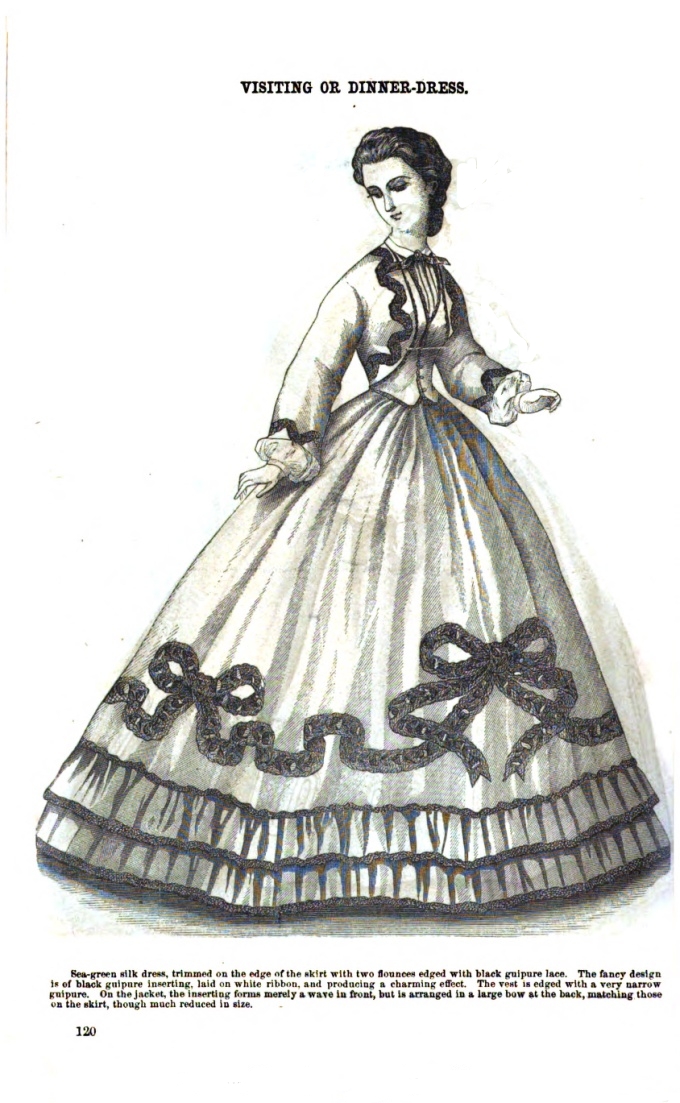
Godey's Autograph Bedquilt - April 1864


AUTOGRAPH BEDQUILT

The autograph bedquilt is made by obtaining the signatures of friends or relatives written upon pieces of white material.  These pieces may be square, octagon, round, diamond, or heart shaped, or indeed cut into any form to suit the taste of the maker.  After they are cut they should be strained tightly over a card, to make a smooth, even surface for the writing, which should be done in indelible ink.  Muslin, linen, or silk can be used, the silk being the handsomest, while the linen makes the best surface for the signature.  The cards may be sent by mail to friends at a distance.
After the names are written, the white pieces can be either sewed down upon, or set into, squares of colored material, and these squares, sewed together, form the quilt.
In quilting, select such a pattern as will leave the name free from the quilting stitches.
Smaller pieces of white silk (with the autographs written in miniature), alternated with colored silk, and made into a pincushion or sofa cushion make a very pretty album of affection.


Wednesday, February 20, 2013

Sarah Flickwir Quilt


Sarah Flickwir Quilt

I stumbled on this quilt at the website of the Philadelphia Museum of Art.  It's a friendship album quilt signed by the family and friends of Sarah Flickwir.  It comes from Philadelphia and was made about 1840 - 1846.

Please take the time to visit the website and read about 19th century friendship quilts - it's quite a good summary of  signature album quilts.


Thursday, February 14, 2013

What's Your Favorite Block?

I had a week's holiday at lovely Mallacoota in Far East Gippsland.  I finished two blocks, one of which I can't show you yet.  The other is a second Elizabeth Cowan block.


The first one I made had the colours reversed, this one matches the original block.

It's great to see all your photos and blogs about your work in progress.  It takes time to photograph the blocks and write blog posts so thank you for your effort.  Here are a few show and tell pictures which deserve a second look.


Wendy of Legend and Lace sent me this photo of Nancy Smith's Block 4. Wendy's needleturn is perfect, if you want to find out more about back basting applique her blog is a good place to start.


Carole from Wheels on the Warrandyte Bus has a lovely blue Block 4 which she finished on a delayed homeward commute.  I like the way the curves on the fabric echo the curves of the applique.


Michelle of  Buttontree Lane has only had the patterns a short while, but her choice of fabric is amazing! The mix of traditional patterns and contempory prints is a remarkable fusion.  I'm looking forward to what she chooses next.

Do you have a favourite block so far?  They feel a bit like children to me so I don't have a favourite, but Nancy Smith's block is particularly nice.


Friday, February 1, 2013

A Block for William and Harry

The Royal Palm Block

There are two blocks of this design in the Chester Criswell Quilt, one for six year old William and one for three year old Harry Clendenen.


William Clendenen

Harry Clendenen

The blocks were made by their mother Elizabeth Clendenen.  Elizabeth was one of Mary Criswell's many cousins. Elizabeth and her husband Robert didn't live in Chester County; they moved around quite a bit and settled in the Baltimore area.

The names William and Harry suggested the block's name - The Royal Palm.  The pattern is available on the website now.  The feedback on the blocks and the stories is very positive, thank you so much, I hope you all enjoy this one too.

Remember, you don't have to use traditional reproduction fabrics for these blocks.  If you want to see some Very Different Blocks take a look at Michelle's blocks on her blog http://buttontreelane.blogspot.com.au . Now that's a horse of a different colour!

P.S.  Harry's full name was Isaac Henry;  in the pattern I've called him 'Harry' five times and 'Isaac' once.


Royal Palms - Wikipedia photo


Saturday, January 26, 2013

Photos of Reuben Stubbs' Block

Here are the first six blocks.  How many do you have? Are you ready for Block 7 on 1st February?


Here are the links to the photos of each block.


And here are the photos for Block 6.  You can add your photo here if you show it on your blog.


Instructions for Linking Up Your Blog:

1. Write your blog post. Publish it on your blog.

2. Copy the link of the specific blog post. This is not just the link to your blog itself (www.chestercriswellquilt.blogspot.com), but the link to the specific post:
(http://chestercriswellquilt.blogspot.com.au/2012/08/hows-it-going.html)

3. Click the blue link up button above and paste your link into the box.

Thursday, January 17, 2013

Welcome to My Needleturn

While working on this quilt I have been amazed by the many different ways there are to sew one piece of fabric to another.  Needleturn, back basting, freezer paper on top, freezer paper underneath, starch, gel pens ....  the list goes on and on.  A number of readers have shared photos of their Work In Progress - we love to see how you do what you do - and I thought it was time to show you how I tackle the applique blocks.

I had the Chester Criswell quilt in my possession for about 25 years before I started the current project.  I was frightened by the thought of all that applique.  When my patchwork group did a session on needleturn I found myself busy doing ... anything else.

Facing my fears, I signed up for a course with Quilt University titled Hawaiian Quilting 101.  It was wonderful.  The instruction was clear, starting from zero and moving step by step through the hand applique and the quilting process.  My piece is still a UFO, but this is my first ever needleturn project.


Hawaiian Quilting UFO


I use the instructions from Hawaiian Quilting 101 to make the CCCQ blocks.  This is how I made Reuben Stubb's block.

I fold the fabric in half and in half again, pressing lightly, and pin the paper pattern to the fabric.


Cutting from folded fabric

I cut out the fabric adding a quarter inch allowance to the pattern.  I do this by eye without marking the fabric.


Fabric piece cut from paper pattern

I baste the applique to the background using a contrasting 'ugly' thread (so you want to get rid of it as soon as possible.)

Basted applique

Then I start sewing, turning under the seam allowance and checking with the paper pattern as I go.  That's all.  I don't use freezer paper and I occasionally use a marking pen.

The pattern emerges from chaos
I love the way the pattern appears as the sewing continues.  I've also found that the more I sew the more I enjoy it.  Needleturn applique is just like Green Eggs and Ham.

Wednesday, January 16, 2013

Quilts in the Baltimore Manner

If there was one exhibit I could go to this year it would be to Colonial Williamsburg and the Quilts in the Baltimore Manner exhibition.

http://www.colonialwilliamsburg.com/do/art-museums/rockefeller-museum/quilts-in-baltimore/


There are some pictures of the gallery on the Quaker Quilts blog

http://www.quakerquilthistory.com/2012/11/a-quaker-quilt-and-apple-pie-ridge.html

and here.
http://www.quakerquilthistory.com/2012/11/quilts-in-baltimore-manner.html

Barbara Brackman has some great closeups from the exhibit on her blog
http://barbarabrackman.blogspot.com.au/2012/11/quilts-at-dar-museum.html

Barbara has focused on the detail of the applique and the stitching around each shape.  We usually try our best to hide the stitching but many of the quilters here used the stitching as embroidery to add to the design.

Wednesday, January 9, 2013

Block 6 Reuben Stubbs

The pattern for Block 6 was sent out through cyberspace this week, so The First Year is halfway done!  I hear from a few people who are keeping up with the blocks, how are you fairing?

Reuben Stubbs, Peach Bottom
I've chosen Reuben's story to go along with this block.  Can you see that it's the top left hand corner of the original quilt?  Reuben was a Quaker and is recorded as a conscientious objector in the American Civil War.  I love the name 'Peach Bottom'. I've tried to find our what 'bottom' means in a place name, but you can't Google 'what does bottom mean?'

There are two more blocks in the quilt made from the same pattern.

Ellen Cummins, West Philadelphia
Humphrey Hood, West Philadelphia

Here the applique is made from a single fabric and the design is slightly stretched.  I can't find any information about Ellen or Humphrey.  Who knows, Humphrey Hood could be the name of Ellen's cat!


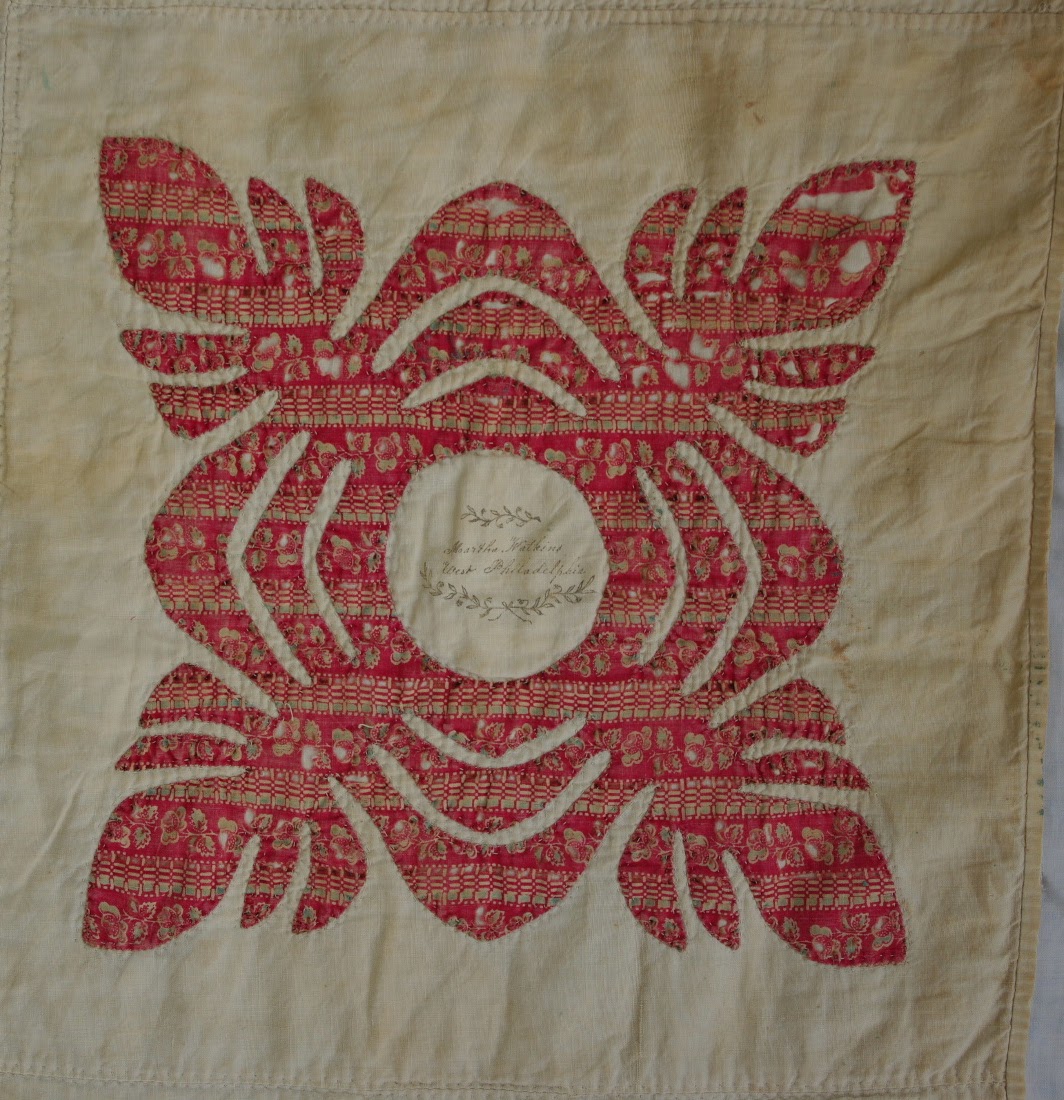
Martha Watkins, West Philadelphia

Martha's block is at right angles to Ellen's block.  The strongly striped fabric is an interesting choice for this applique pattern, I like the floral in Ellen's block better.

If you haven't started the Chester Criswell Quilt you can join in at any time.  You don't have to sign up for the whole year, each pattern is available separately.  You can find all the pattern  here at www.twobitspatches.com .